Keeping a plantation in optimal condition is demanding work that requires constant supervision in order to maintain ideal growing conditions by controlling pests and diseases, managing weed growth and improving soils.
In this regard, Agricultural #Mulching -known in Spanish as “Acolchado Agrícola”- is a sustainable technique currently in the exploratory phase at #SiCarFarms, used to nourish and care for our Key lime and Persian lime groves, adding to our vision and to a #sustainable culture.
Agricultural #Mulching or #Acolchado is known for creating a physical barrier, which consists of placing a layer made up of different materials over the surface of the planting soil in order to conserve moisture, regulate temperature and develop an ecosystem that nourishes the soil. There are two main types of mulching:
Inorganic Mulching
In this category of #Mulching, inorganic materials are used -as the name indicates- such as fine gravel, gravel, marble chips, crushed ceramic, expanded clay and volcanic rock
Mineral
These are considered to include every kind of non-biodegradable material, extending their service life even beyond that of plastics; some of them are gravel, stones, etc., and they are widely used in ornamental gardening
Plastics
The thickness of the polyethylene film used for mulching varies widely and depends on how long it will be used in the crop and on the farming techniques applied -to name just a few factors- since the thickness determines how durable that mulch will be.
Mulch types are classified according to the additives and the color of the polyethylene film, since depending on its color the mulch has different properties.
- Transparent: In this case, with no pigment or additive, it is used to raise the soil temperature and prevent water from evaporating at the surface; it does not control weeds, which can grow underneath the plastic.
- Black: Used exclusively to control weeds and to prevent water from evaporating out of the soil. This is the type of mulch that heats up the most, although it does not transfer that radiation to the soil. A clear disadvantage is that it can burn the plant’s tissues if they come into contact with the film.
- Gray: It increases weed control and warms the soil less than black plastic; by reflecting a good part of the sun’s radiation, it stimulates increased photosynthesis in the plants.
- Metallic: Used very much like gray plastic, but it also repels birds and insects because of the way its color reflects the sunlight.
- Brown or translucent green: This type of plastic mulch controls weeds and lets the soil warm up, since it transmits part of the radiation that strikes it, and it also reduces heat loss during the night.
Organic Mulching
Biodegradable
This type of #Mulching uses -as the name says- exclusively organic materials such as peat, leaf mold, decomposed manure, straw, compost, sawdust, bark, wood chips or dried grass clippings, corn #silage, among others. The main advantage of these types of #mulches is that, besides protecting, they greatly improve soil fertility, making this practice an alternative that is friendly to the #environment, unlike #plastic #mulching.
In our case, the #Organic #Mulching project is a mixture of sugarcane bagasse (a byproduct of the sugar industry), corn #silage, chopped corn #forage and Johnson grass (Sorghum halepense). The mulch layer ranges between 5, 10 and 20 cm thick and it is applied either in a basin (around the tree) or along the entire row.
In the case of corn, SiCar Farms uses the forage to add to its Organic Mulching, the grain goes to animal or human consumption and the leaves are sold, underscoring its Zero Waste policy, since no part of the product goes to waste.
Living
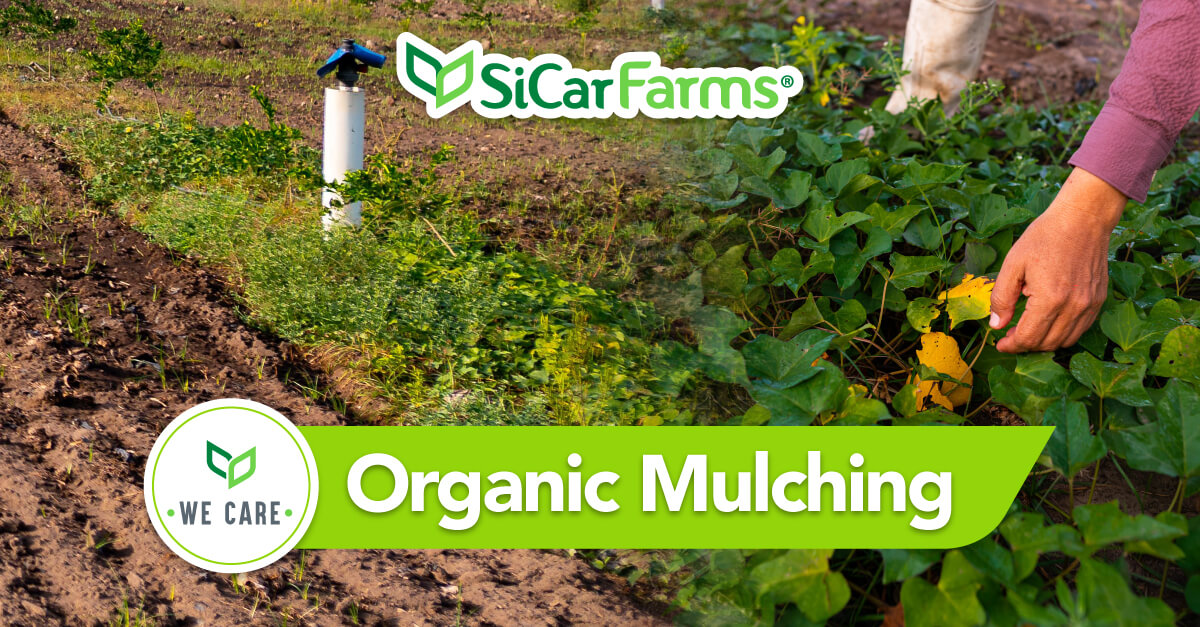
This type of mulching is known as cover cropping, in which a special type of plant is placed so that it acts as a barrier and as protection, such as the sweet potato root that is currently being implemented as a strategy in our fields. This crop is chosen because its root is not a climber; it spreads across the corresponding area to cover our #KeyLime groves and thus obtain all of its benefits.
One characteristic to keep in mind with #Mulches is that they do not provide nutrients; those made with stones are suitable for steeply sloped land and around water runoff channels.
The best and most advisable way to apply mulch is before the tree or the plant begins to sprout. That is how the new plant will get the greatest contribution of nutrients, or the greatest benefit from the soil improvement that takes place.
Benefits of Organic Mulching
- It protects the crop from high or very low temperatures.
- It improves soil life by increasing microorganisms and soil fauna.
- Moisture conservation and, therefore, optimized water use by reducing evaporation.
- Incorporation of organic matter through the decomposition of the material used
- Contribution of beneficial microorganisms (lactic acid bacteria in corn silage)
- Pairing with other technologies, such as the use of compost, worm leachate or other eco-technologies.
- Nesting of endemic birds.
At #SiCarFarms, our #KeyLime groves have particular needs so that we can offer you the best quality on the market, which is why we take an active part in researching sustainable farming techniques such as Organic Mulching; in doing so, we also promote the circular economy.
Our commitment to the quality of our products goes further, since we have set ourselves the goal of caring for the environment while producing to high standards. These are efforts that are reflected internationally by placing the #KeyLime among the favorites of countries on every continent.
Get to know us, we are #SiCarFarms!